Using Camera Traps to Monitor Seasonal and Diel Activity Patterns of Wood Ducks (Axis Sponsa) During the Breeding Season
Cindy L. Von Haugg
M.S. Student, Clemson University

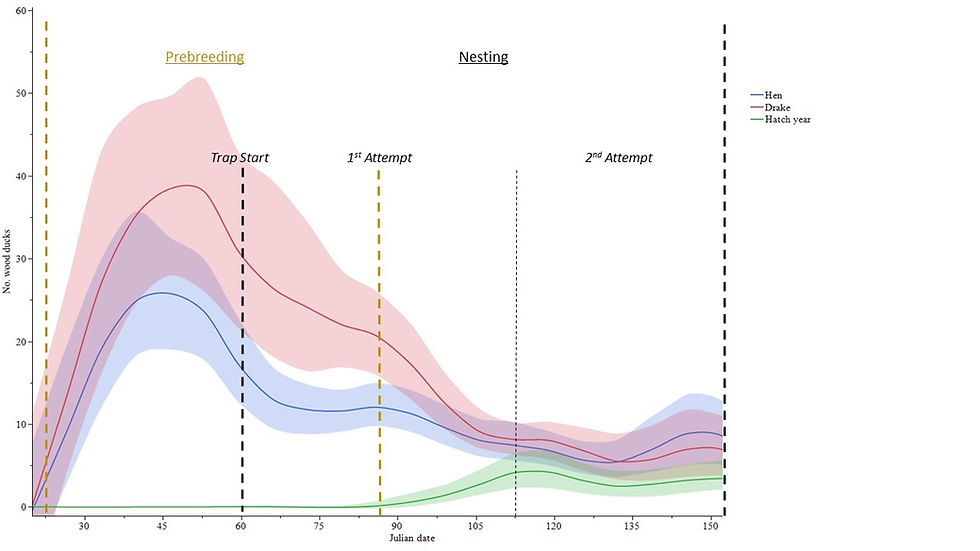

The reproductive ecology of cavity-nesting Aix sponsa (Wood Duck) has long gone understudied due to the secretive nature of this species and the inability to estimate the vital rates of the population. Trapping and monitoring individual activity has been successfully used to uncover the behavior and habitat selection of numerous species. However, migratory species add additional difficulty to diagnosing the proper timing of trapping efforts. Uncovering successful trapping techniques is required to maximize research efforts and increase our understanding of cavity-nesting Wood Ducks. Moreover, timing trapping effort is fundamental to successfully trapping locally nesting Wood Duck hens. Between 11 January and 30 June 2023, we monitored trap sites (n = 41). We collected trail camera images with Wood Ducks (n = 2,271 frames) to evaluate seasonal and diel activity patterns of hen, drake, and hatch-year Wood Ducks in coastal South Carolina. Our analysis of images of hen (n = 1,641), drake (n = 2,358), and hatch-year (n = 341) Wood Ducks showed that the occurrence of each differed among months, and the highest densities of hens occurred in January, February, and May. Our results suggest setting traps no earlier than 1 March to increase the chance of trapping a locally nesting hen. Our estimates also suggest the pre-breeding phase occurred from mid-January to late March; the first nesting attempts occurred from early March to late April, and the second nesting attempts began around late April. Wood Duck (96.5%) and hen-specific (96.3%) activity were highest during diurnal periods, suggesting trap site visits should be avoided at this time to minimize disturbance. Using these results as guidelines for future trapping efforts could greatly improve the trapping success of Wood Duck hens during the breeding season, thus increasing our understanding of the reproductive ecology of cavity-nesting Wood Ducks and best-informing management decisions.
Figure 1. The four trap phases, one week per phase, were used to accustom the wood duck (Aix sponsa) to the trap site over 28 days: 1) bait only; 2) the wire was positioned linear across the trap site between the observed avenue of approach and the bait; 3) the wire was positioned in a circle or rectangle, if it was a rectangular trap, with the bait placed inside; and 4) the trap was set. The trap entrance was configured into a funnel 20 cm at the narrowest point and 1.9 cm, heavy-duty nylon mesh, poultry netting, or top panels, if it was a rectangular trap, were zip-tied across the top (North and Hicks 2017). The set trap was approximately 2.5 m in diameter or length. Trapping efforts were conducted from 11 January to 30 June 2023 at Ernest F. Hollings ACE Basin National Wildlife Refuge in Colleton, Charleston, and Beaufort Counties, Waccamaw National Wildlife Refuge in Georgetown, Horry, and Marion counties, Santee National Wildlife Refuge in Clarendon County, Clemson University’s Pee Dee Research and Education Center in Darlington and Florence counties, and privately-owned Witherspoon Island in Darlington County, South Carolina, USA.
Figure 2. The number of wood duck (Aix sponsa) observed in trail camera frames across all trap sites (n = 39). Hen-to-drake ratios and overall wood duck presence were used to estimate the generalized timing of phases (e.g., pre-breeding [gold] and nesting [black]) throughout the breeding season in the Southeastern U.S. Our data suggest setting traps no earlier than 1 March to increase the chance of trapping a locally nesting hen. Our results also indicate that the pre-breeding phase occurs from mid-January to late March; the first nesting attempts occur from early March to late April, and the second nesting attempts begin around late April. Trapping efforts were conducted from 11 January to 30 June 2023 at Ernest F. Hollings ACE Basin National Wildlife Refuge in Colleton, Charleston, and Beaufort counties, Waccamaw National Wildlife Refuge in Georgetown, Horry, and Marion counties, Santee National Wildlife Refuge in Clarendon County, Clemson University’s Pee Dee Research and Education Center in Darlington and Florence counties, and privately-owned Witherspoon Island in Darlington County, South Carolina, USA
Figure 3. Tukey-Kramer Honestly Significant Difference test comparing the difference in mean number of wood duck (Aix sponsa) observed with trail cameras each month across trap sites (n = 39). Error bars indicate 95% confidence intervals, and significant differences are represented with different letters. Trapping efforts were conducted from 11 January to 30 June 2023 at Ernest F. Hollings ACE Basin National Wildlife Refuge in Colleton, Charleston, and Beaufort Counties, Waccamaw National Wildlife Refuge in Georgetown, Horry, and Marion counties, Santee National Wildlife Refuge in Clarendon County, Clemson University’s Pee Dee Research and Education Center in Darlington and Florence counties, and privately-owned Witherspoon Island in Darlington County, South Carolina, USA.